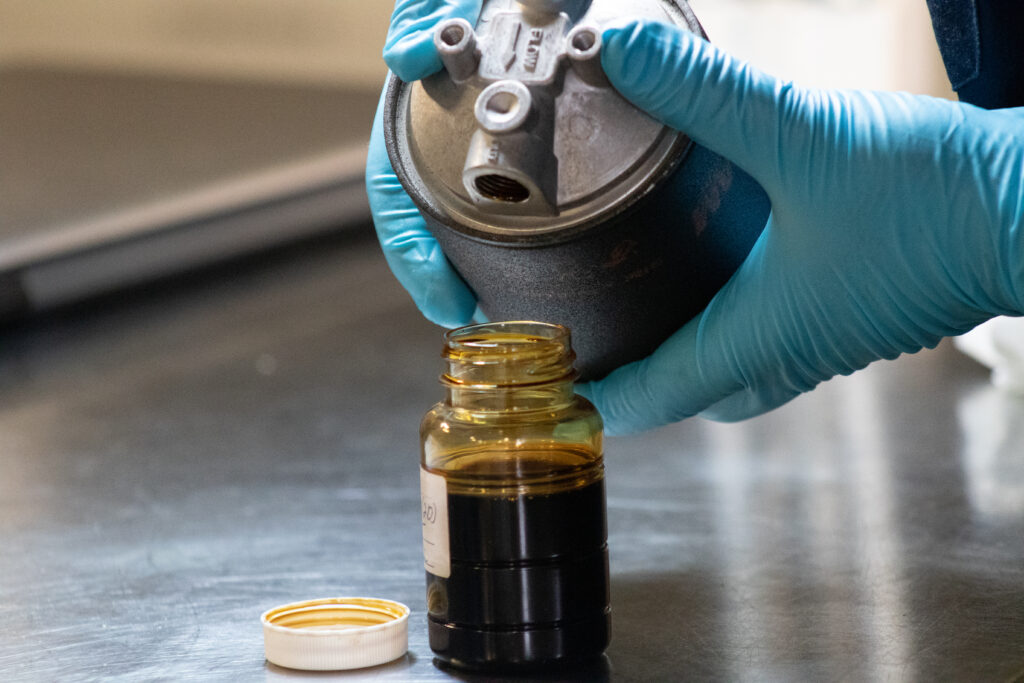
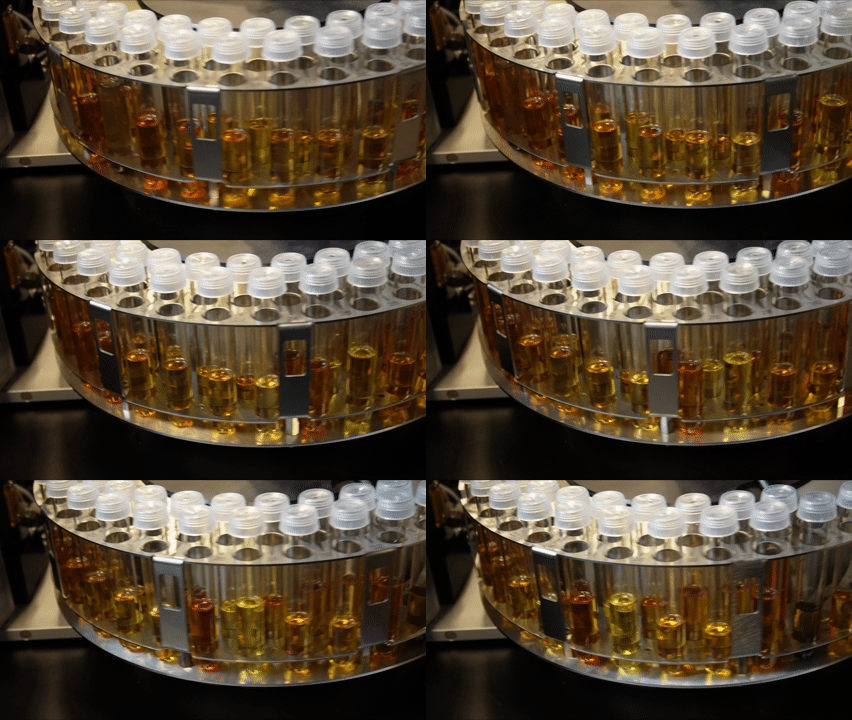
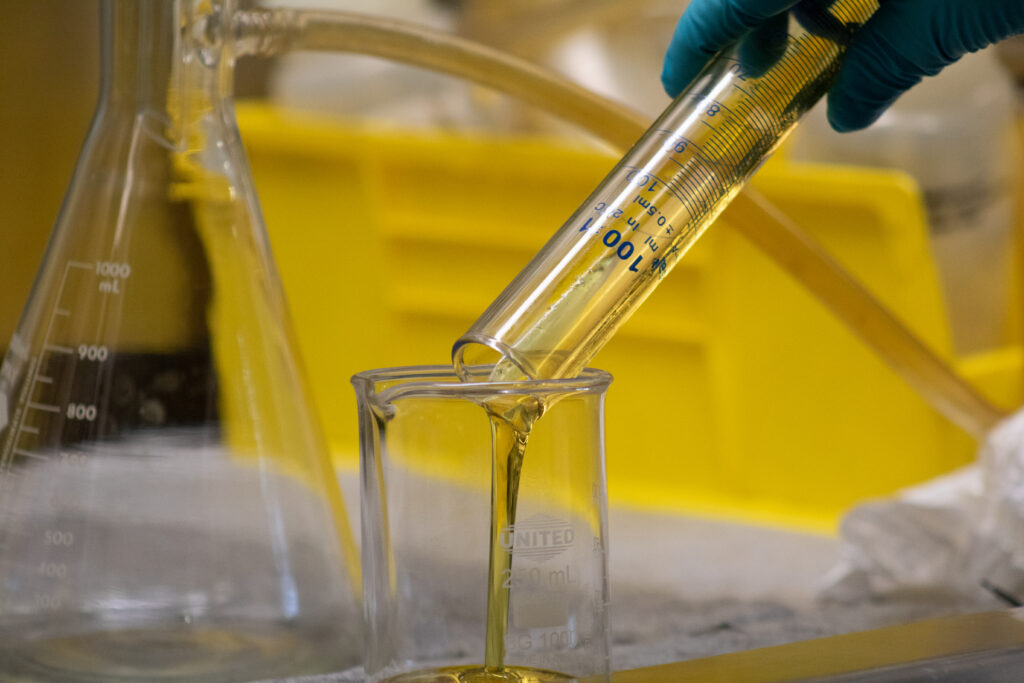
Oil analysis test slate includes RDE Spectroscopy, FTIR, wear analysis (FerroQ), water concentration, viscosity @ 40C. Recommended for Pumps, Motors, and Gearboxes. 100ml of oil required to complete the full analysis.
HCC Lubricant Analysis
HCC Lubricant Analysis includes RDE Spectroscopy, FTIR, wear analysis (DR-III), water concentration, ISO particle count, viscosity @ 40C, and RULER. 100ml of oil required to complete the full analysis.
Oil Cleanliness Slate
Slate includes ISO particle count and water concentration. 50ml of oil required to complete the full analysis.
Coolant Test Slate
Test Slate includes Visual Inspection, pH, reserve alkalinity, % glycol, freezing and boiling point by refractometer, total dissolved solids, and RDE Spectroscopy. 100mL of oil required to complete the full analysis.
EHC Test Slate
Test Slate includes water concentration, ISO particle count, RULER, kinematic viscosity @ 40C, elemental analysis via RDE, and MPC. 100mL of oil required to complete the full analysis.
RPVOT
Rotating Pressure Vessel Oxidation Test with Tannas Quantum “Dry Cylinder” sample tester. Reported per ASTM D2272.
Diesel Engine Test Slate
Test Slate includes FerroQ, RDE Spectroscopy, FTIR, Vapor Pro, Kinematic Viscosity @ 40C and 100C, and RULER. 100mL of oil required to complete the full analysis.
Engine Oil Test Slate
Test Slate includes FTIR, FerroQ, Water PPM, Viscosity @ 40C and 100C, Elemental Analysis, and RULER.
Turbine Oil Test Slate
Test Slate includes RDE Spectroscopy, FTIR, wear analysis (DR-III), water concentration, ISO particle count, viscosity @ 40C, RULER, and MPC. 100mL of oil required to complete the full analysis.
Membrane Patch Colorimetry
Using method ASTM D7843, varnish potential is used to look at the amount of soft varnish particulate present in the oil. In areas of low flow or cooler conditions, soft varnish particulate can coat parts and cause seizing or sticking, ultimately leading to premature failure. 100mL of oil required to complete the full analysis.
Demulsibility
Demulsibility/Water Separability testing per ASTM D1401. Testing performed at either 54°C or 82°C per testing standard.
Direct Reading Ferrography (DR-III)
This process is used to determine wear levels in oil. This optical technique separates ferrous debris from the oil by a magnetic field. As the debris is captured by the magnetic field, it interrupts a light source that is being measured by a sensor. The decrease in light transmitted through the sample corresponds to the quantity of ferrous debris present in the sample. 100mL of oil required to complete the full analysis.
TAN/TBN
Total Acid Number is designed to look at the total amount of acidic components present in the oil. Acid Number is performed using a titration method. The trendable value is reported in mg KOH/g of oil.
The Total Base Number is designed to look at the total amount of detergent additive present in the oil. Trending base number value is particularly important in engine oil applications where there are blow by gases present, which can quickly deplete the additive package. Base Number is performed using a titration method. The trendable value is reported in mg KOH/g of oil.
Oil Filter Microscopy
Creation of filter patch and analysis via optical microscope. 100mL of oil required to complete the full analysis.
Vapor Pro Moisture Analysis
Measurement of water (ppm) in oil using a relative humidity sensor – Per ASTM D7546